
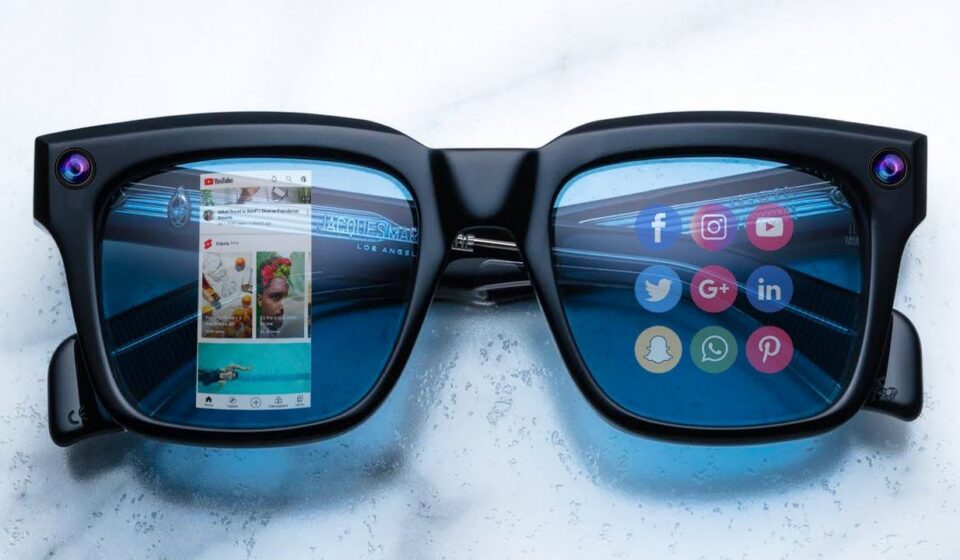
A crystal that could make AR glasses real: researchers unveil molybdenum oxychloride, a material so thin and efficient it could finally enable smart contact lenses and ultrathin augmented reality displays

Scientists mapped the optical behavior of molybdenum oxychloride in detail for the first time. The crystal exhibits extreme anisotropy, responding differently to light based on direction. In one orientation it reflects like a metal. In another it transmits light like glass.
This dual nature stems from its atomic structure. Layers allow precise control over light propagation at scales far below conventional optics. Measurements confirm strong performance across visible wavelengths.
Light Manipulation Capabilities
The material demonstrates one of the highest birefringence values recorded in natural crystals, around 2.2 in the plane. This enables efficient splitting and bending of light rays. Such control supports compact polarization components essential for display systems.
Researchers also noted epsilon-near-zero effects in certain frequencies. These properties facilitate advanced waveguiding and light steering within extremely thin layers. The findings come from collaborative work involving XPANCEO and international partners.
Applications in Augmented Reality
Engineers see opportunities for ultrathin augmented reality displays built from this crystal. Traditional components limit how small and light AR glasses can become. Molybdenum oxychloride layers could replace bulkier optics while maintaining image quality.
Integration into near-eye systems may reduce overall device thickness dramatically. This approach addresses heat and power challenges in wearable formats. Prototypes remain in early stages, yet the material’s efficiency points toward practical implementations.
Path to Smart Contact Lenses
Smart contact lenses require transparent, flexible components that handle complex optics without obstructing vision. Molybdenum oxychloride’s thinness, measured in nanometers, aligns with these constraints. Its light control could support overlay displays or sensing functions.
Challenges include biocompatibility and large-scale production. Ongoing studies examine integration with soft lens materials. Success would open avenues for health monitoring combined with visual augmentation in a nearly invisible form.
Broader Implications for Photonics
Beyond consumer wearables, the crystal holds value for photonic chips and sensors. Its properties support miniaturization in data processing and imaging devices. Teams continue refining fabrication techniques to harness these traits reliably.
The research establishes a foundation for next-generation optical systems. Further exploration may uncover additional uses in communications and computing. Scientists emphasize measured progress grounded in verified experimental data.